Can you build conviction for someone else's idea?
You can't fake long-term obsession with problems you've never felt yourself.

Every week on r/startups and r/Entrepreneur, I see first-time founders ask strangers what problems they should solve. As if conviction is something you can magically build, just like that.
Or worse, they’d pitch their take on the most generic first-world problems that have already been “solved” a thousand times. All with no clear point of differentiation and a complete lack of understanding of why the previous attempts have failed.
Aside from being a terrible approach to validate your startup idea, the question here isn’t just what problem to solve - but whether you’re obsessed enough with the problem to be the right person to solve it.
You can’t fake long-term obsession with problems you’ve never felt yourself.
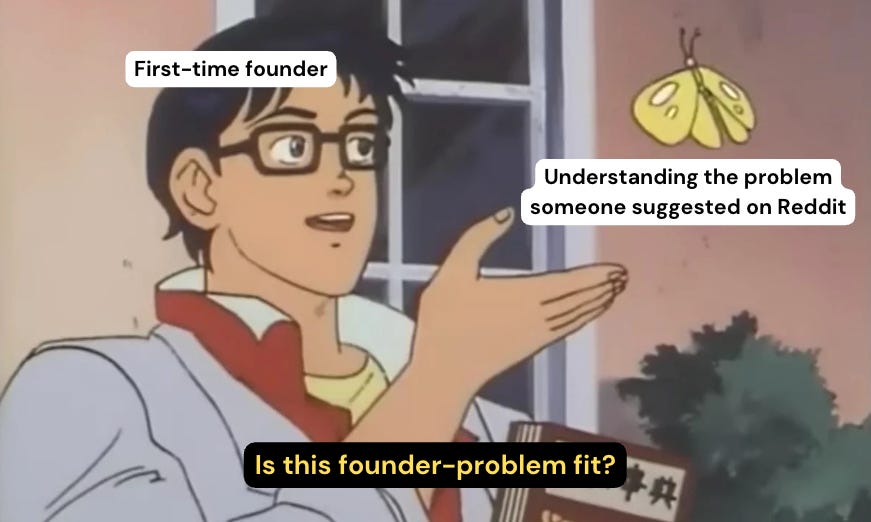
What founder-problem fit looks like
Imagine one of them is pitching to you (as an investor or a first customer).
“So...I did some online research and found this gap in the market...”
“I’ve lived through this problem for X years, and from experience I know how this costs me and the target market $X every day and X hours of wasted time.”
Who would you want to back and advocate for?
Some of the most successful startups today were created by founders building solutions for their own problems. Shopify’s founder Tobias Lütke initially just wanted to sell snowboards online. Every eCommerce platform back in 2004 was clunky and expensive, so he built his own. Other retailers saw it, asked to use it, and that became Shopify.
The same pattern repeated for Stripe, Dropbox, Zapier, and Amplitude:
Stripe: Patrick Collison needed easier payment processing for his previous startup
Dropbox: Drew Houston kept forgetting his USB drive
Zapier: Wade Foster was tired of manually moving data between business tools
Amplitude: Spenser Skates needed better analytics for his previous startup
All were born from their founders solving problems found through lived experiences.
They didn’t ask strangers what product they should build. Many weren’t even their first startup attempts. They were building something else or working for someone else when they stumbled upon the problem, and that led them to build the startup.
But what if you don’t have it naturally?
Founder-problem fit isn’t about having the perfect industry background or having the luck of stumbling upon the right problem you care about. You can develop it, but you can’t fake it. There are no shortcuts.
I know this because I didn’t start with a strong founder-problem fit for our Shopify apps. My co-founders ideated these apps based on their observation of what we needed when running Hot Pot Club, and built them out of curiosity about micro-SaaS.
I felt the pain, but not deep enough to want to build an app for it.
And my initial hesitation was more than that. The problem was real for Shopify merchants, but I felt like I was contributing to over-consumerism. I didn’t want to “sell the shovel” in an already saturated Shopify app ecosystem.
I told my co-founders it was hard enough to be the face of an app idea that wasn’t mine, let alone build conviction for one that didn’t align with my values. But as an INFJ and Encourager (DISC), I believe the people I work with are ultimately more important than the specific product. So I stayed.
For our first two Shopify apps, all I did was surface-level work. Did some online research, spoke to some merchants, picked a niche positioning, and ran some ads on the App Store with minimal spend.
Our competitors were targeting everyone, so we were able to take a small slice of the pie by positioning ourselves for specific industries. We started getting inbound installs without reliance on ads. We even managed to rank globally within the top 3 (now 1st and 2nd for our main positioning).
It worked well for the amount of effort I put into it. Honestly, my co-founders should’ve questioned whether I was the right person to team up with when I clearly had no conviction for what they’ve built.
But they kept me on anyway, because they valued our working relationship more than squeezing optimal performance out of me.

Early Bird
Two years later, I went through my third redundancy. Around the same time, my co-founders were looking to build their next app.
I actually wanted to build something beyond Shopify apps. But after exploring a few different ideas together and building half an MVP, my co-founders decided to keep building on Shopify.
After hearing me constantly talking about demand validation (for startups in general), they became interested in pre-orders, deposits and back-in-stock. It’s a saturated app category, but they believed they could build a better UX. (Which they did! The product quality was never the issue.)
This was how Early Bird came to be.
I was burnt out from betting on the wrong startup founders. There’s a saying, “VCs bet their money. Founders bet their time.” I’d add that early startup hires bet with their time they’ll never get back too.
Between joining another early-stage startup as an employee and betting on myself, I decided to give Early Bird a solid go. I needed closure from my redundancies, and I wanted to practice what I preach - to see what I can do without bureaucracy, albeit with no marketing budget.
While I saw the value of running pre-orders - capturing expressions of interest first (waitlist), then commitment to buy (pre-orders & deposits), I still faced the same problem: How do you build conviction when you didn’t ideate the product yourself?
Building conviction
While we still had our actual Hot Pot Club and Beyond Mondays Shopify stores to test our apps on, we weren’t actively selling products anymore. There were so many nuances in eCommerce that can only be understood when operating a business first-hand. Talking with merchants wasn’t enough.
I needed to get back into the trenches.
I decided the best approach was to take on consulting work with a few brands. I brought fresh perspectives to their eCommerce businesses, and in return, I got to experience their inventory planning headaches, customer communication chaos, and fulfillment nightmares.
I also treated every support ticket and merchant onboarding as a consulting session. Not just how to set up our app, but understanding the outcome they wanted and all the challenges standing in the way.
Merchants thanked us for building a reliable pre-order app with thoughtful UX. For going above and beyond to audit their workflows and customer purchase journey. For guiding them on how to market their pre-orders, not just how to use our app.
They all had different reasons for running pre-orders. To fund their production, to validate demand before committing to a large inventory order, or to avoid losing sales to competitors. Every chat deepened my understanding of each problem.
Along the way, I realised the world is a museum of passion projects. Knowing I was able to contribute and play a small part in everyone’s journey made me feel better. I felt I was in a unique position to guide Shopify merchants on how to market their pre-orders when few other app competitors care about the outcome like I do.
Bit by bit, my conviction grew.
I became more confident to respond to questions online that others couldn’t (or wouldn’t) answer. I knew what I was talking about as I’ve now experienced the frustrations first-hand, and I genuinely wanted to find the best approach for each scenario, whether they became customers or not.
I’ve found meaning and purpose in running our Shopify pre-order app.
This gave us a competitive edge in a very saturated app category. Even when we had little product feature differentiation and couldn’t compete in shipping speed, since most competitors were hiring offshore developers.
We quickly rose from the bottom of Page 2 (>48th) to the Top 10 globally in half a year. Even the top 3 for some keywords. We started showing up on Google and LLM search results for specific scenarios.
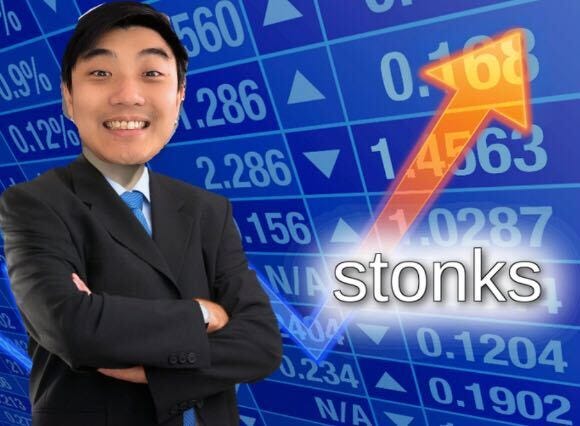
What started as a way for me to build conviction became an organic growth flywheel! It took us just over a year to hit the MRR milestone that took us three years with for our first two apps - with less than $2K marketing spend.
I’m glad it worked out for Early Bird in the end, but it was nearly a full year of daily grinding before I felt any conviction for just ONE of my co-founders’ app ideas. By the time I did, it was too late to re-align on whom to serve and what to build.
You don’t have to do it this way.
Five questions to test your conviction:
Before you spend months building a product or join someone to work on their idea as a co-founder, think about whether you have a real founder-problem fit. Ask yourself:
1. Can you articulate this problem so well that customers feel understood?
Anticipating their needs. Understanding their language. Walking through their workflow without having them explain it first. Knowing the limitations and workarounds for specific scenarios. You want customers to go, “I’m finally talking to someone who gets it!!!” (Yes, triple exclamation!!!)
Even if you can’t do this yet, does the problem interest you enough to learn how?
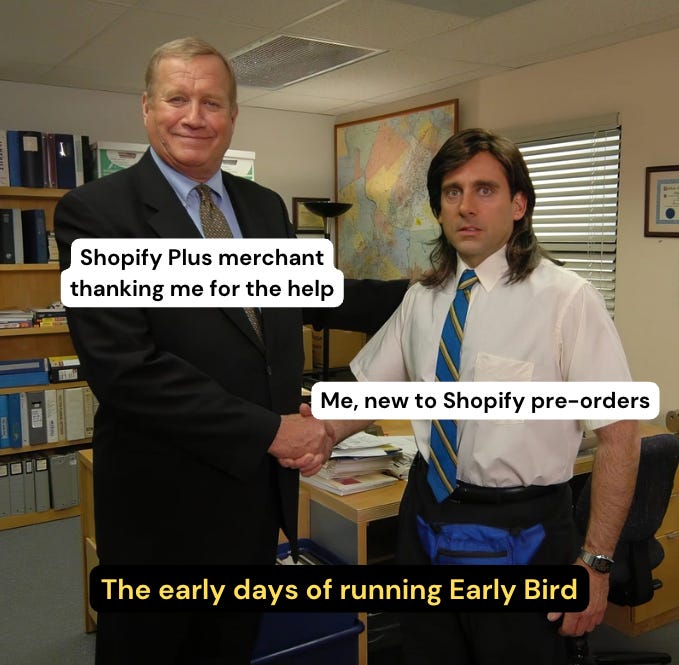
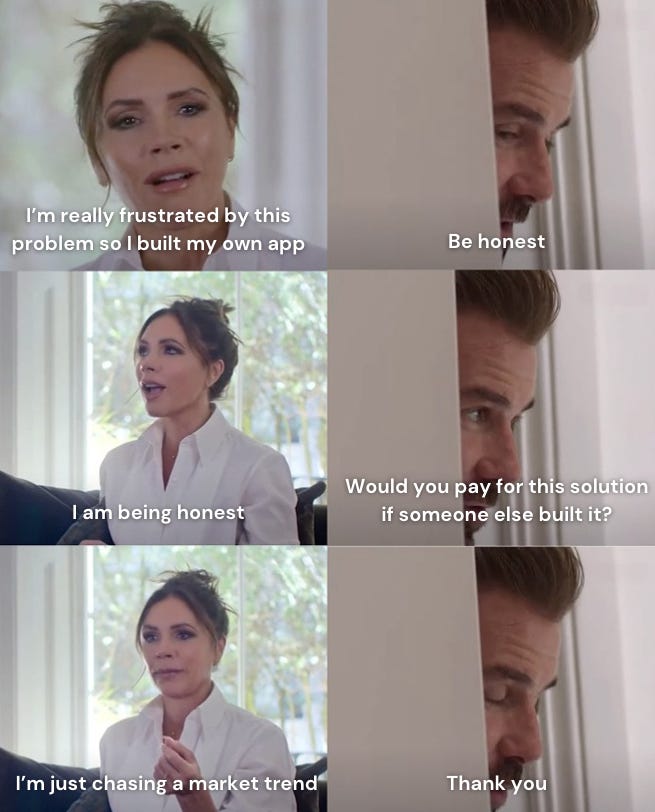
2. Would you pay for this solution if someone else built it?
Be honest. If it’s really that frustrating, why haven’t you already paid for something or hacked together your own solution yet? My friend Nicky Watson (Product Strategist & Experience Designer) always asks me this question when I bounce ideas off her.
Even if you’re not technical, ask yourself if you have at least tried to solve this manually or looked for alternatives. This is a good way to understand whether you’re just chasing opportunities or actually interested in solving the problem.
3. When things get hard (and they will), what will keep you going?
If you’re joining because you’re excited to work with your co-founders, know that there’s always a chance they might lose conviction and pivot back to what’s comfortable.
If you’re building because there’s a big market size, know that the serviceable addressable market tends to be much smaller than you think. Copycats will show up, customers will churn, and venture-backed competitors will outspend you on distribution.
If you’re doing this because you think building a startup seems “fun” or because you want to call yourself a founder, know that you’ll go months without visible progress. Competitors will take shortcuts, build clout on socials, and even degrade you - making you question what’s the point of all this.
It’s a daily mental battle. Only personal frustration and obsession with the problem will keep you going.

4. Have you personally experienced this problem?
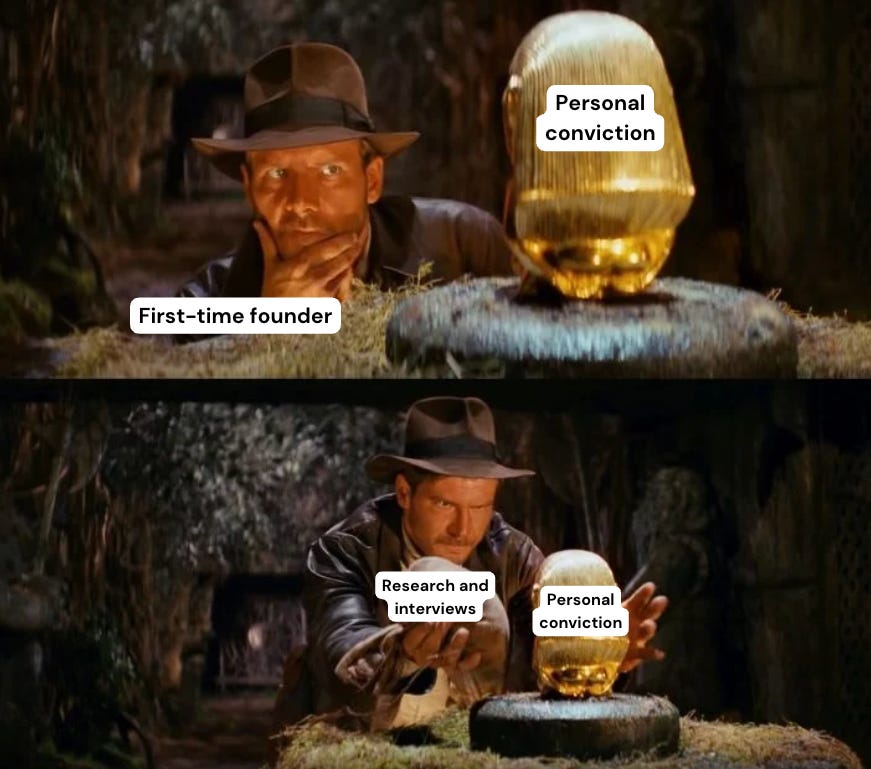
Research is knowledge; experience is what builds conviction.
Research and interviews matter when you’re learning about a new space, but you can’t fake long-term obsession with problems you’ve never felt yourself.
5. Does solving this problem match how you naturally work?
The work you avoid is often what your business needs most.
If you hate sales calls, don’t build an enterprise product. If you don’t enjoy building relationships, don’t build marketplaces. If you need constant external validation, don’t build in a slow-growing niche. If you hate explaining the same thing repeatedly, don’t build a product for non-tech-savvy users.
As an INFJ, I naturally get energised by deep 1-1 conversations and writing long-form educational content. My working style is better suited for products serving the mid to upper market.
My co-founders are builders who naturally gravitate toward serving the mass market - they prefer building elegant, well-designed apps that can run independently, then move on to the next thing. It took me a long time to understand and accept that neither approach is wrong - they’re just different ways of working, best suited for different founders.
We built and positioned our Shopify apps around their product philosophy (they were their apps, after all). Understanding this difference earlier would have saved us a lot of misalignment.

The bottom line
Some founders have built successful startups without a strong founder-problem fit. Through sheer discipline or market timing. But in most cases, you’ll be competing against founders who are genuinely obsessed with solving a problem. Customers’ problems. Because it’s their life’s work, not a pet project.
So before asking “What problem should I solve?” ask yourself: “What problems have I already lived through, or which ones do I care enough about?”
That’s where your conviction lives. Everything else is just market research.
Until next time,
Josiah
Cover photo by Marek Piwnicki.